

Part 1 — Published to Alpha Members
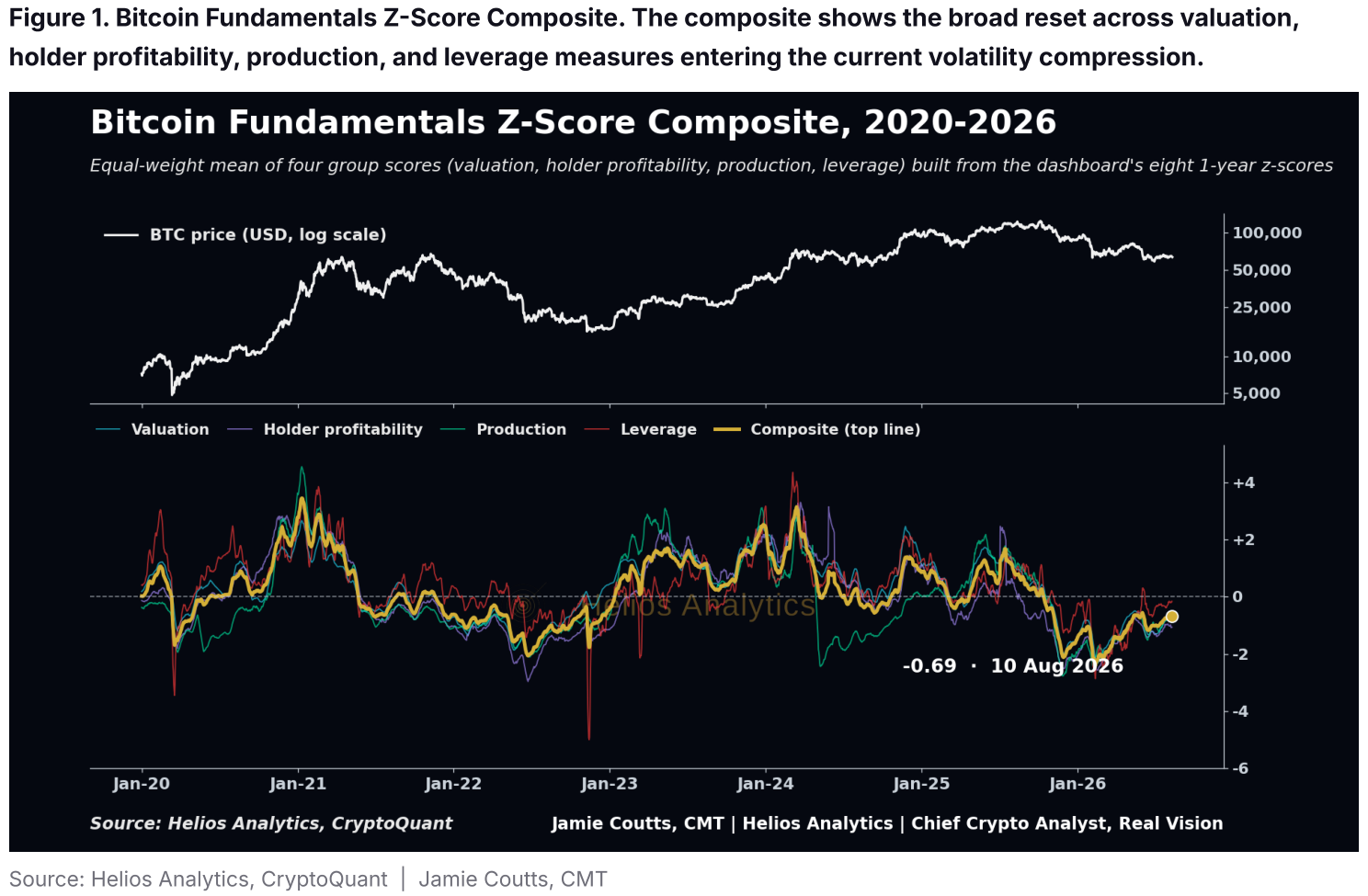
Since the February 6 capitulation low, I've been arguing that Bitcoin was in the accumulation or value zone, with the pieces slowly falling into place for a major low sometime in Q2 but likely Q3. My previous work showed that Bitcoin did not need global liquidity to bottom first. What mattered was whether the market could absorb the tightening and begin to change character as pressure from liquidity, the dollar, and real rates started to ease. Last week, the US Treasury provided a partial answer on the policy side, while Bitcoin delivered a price move that looks like the real thing. It finished up 22%, its best week in more than two years, and is trading around $79,000 as I write this.
Although several parts of the broader framework have yet to confirm, it appears likely that Bitcoin and crypto have put in their major lows.
Global liquidity has bounced from its June low but remains within the broader loss of momentum that began earlier this year, while crypto activity is still recessionary. But as a technician, I respect price action. Bitcoin's move has the characteristics of a cycle inflection across the short and medium term, while the critical weekly regime and the relative trends against Nasdaq and gold have all moved to neutral after more than nine months of bearish action. Higher-timeframe confirmation remains incomplete, but several of the conditions I previously said would change my view have now been met.
Bitcoin's extreme volatility compression, another theme I wrote about this month, also resolved violently higher. Its price regime improved while crypto breadth had already been repairing beneath the surface. Taken together, that is enough for me to move the major low from a possibility to the base case. I had already begun leaning into that possibility in July, deploying 17% of the portfolio from cash on improving breadth and relative strength even while the macro and trend confirmations remained incomplete.
It's not textbook, but when is it ever? The liquidity cycle has always mattered more to me than a rigid four-year Bitcoin clock, and even the roughly five-year refinancing framework I use is not a metronome. Policy is reacting earlier this time. Treasury is shortening average duration by increasing bill issuance, while Andreas Steno's latest work suggests it may also have a temporary reserve bridge via the TGA before the Fed needs to expand its balance sheet. AI is further complicating the economic and financing backdrop. None of this removes the macro risk. Debt continues to grow much faster than the liquidity available to support financial markets, and the AI capex boom itself may eventually stumble. I still think a larger Fed role becomes likely if refinancing pressure persists. The mature and dangerous part of the cycle remains ahead, but Bitcoin appears to be starting to discount the policy response before it fully arrives.
The secular backdrop is also beginning to align with the cyclical turn. Regulatory risk is falling, institutional tokenization is advancing before final legislation arrives, and the building blocks for the agentic economy are falling into place. Over the next 12 months, I expect demand for programmable payments and settlement to accelerate, with tokenization likely to become a much larger part of the story even sooner. At the same time, Bitcoin's relative trend against both Nasdaq and gold is improving, opening the door to renewed capital flows.
Source PDF · page 3After last week's repricing, the question has changed. The 2026 lows remain critical support, but if a new regime is being established, the focus shifts to which crypto assets and related equities can sustain relative strength, fundamental relevance and genuine value accrual. This is the first of a two-part Deep Dive. Part 1 establishes why I think the regime has changed and why I began deploying ahead of full confirmation. Part 2 will focus on portfolio construction and positioning for what comes next.
Key Takeaways
- The major low is now my base case. Bitcoin's volatility compression resolved violently higher, the price regime improved, and crypto breadth had already started repairing before the breakout.
- Global liquidity has improved, but the broader liquidity cycle has not completed. The 12-month GLI rate of change and the detrended impulse have both rebounded since June, yet neither has broken the declining momentum structure in place since early 2026.
- A rigid four-year Bitcoin cycle looks increasingly inadequate. The roughly five-year refinancing cycle is a better structural guide, but earlier policy intervention and AI may make even that cycle less metronomic. Andreas Steno's TGA thesis suggests Treasury may have more capacity to support liquidity before the Fed acts than I previously assumed, but that is a bridge rather than a permanent solution. Debt still outgrows liquidity, and much more support may ultimately be required.
- The activity recession remains in place. Stablecoin supply and active addresses have improved modestly since the low, but the recovery is too small to declare a broader fundamental turn.
- The secular backdrop is getting stronger. Regulatory de-risking, tokenization and machine-native payments are becoming more concrete while Bitcoin begins to repair its relative trend against the Nasdaq and gold.
- I acted before full confirmation. I deployed 17% of the portfolio from cash in July as breadth and relative strength improved into weakness. After the subsequent repricing, the focus now shifts from identifying the low toward durability, relative strength, fundamentals and value accrual.
The Regime Changed
Two weeks ago, the message from Bitcoin's volatility profile was straightforward: the market was approaching a resolution. Volatility had compressed to an extreme, but the compression itself gave no reliable directional signal. The important information would come from what happened when price finally escaped the range.
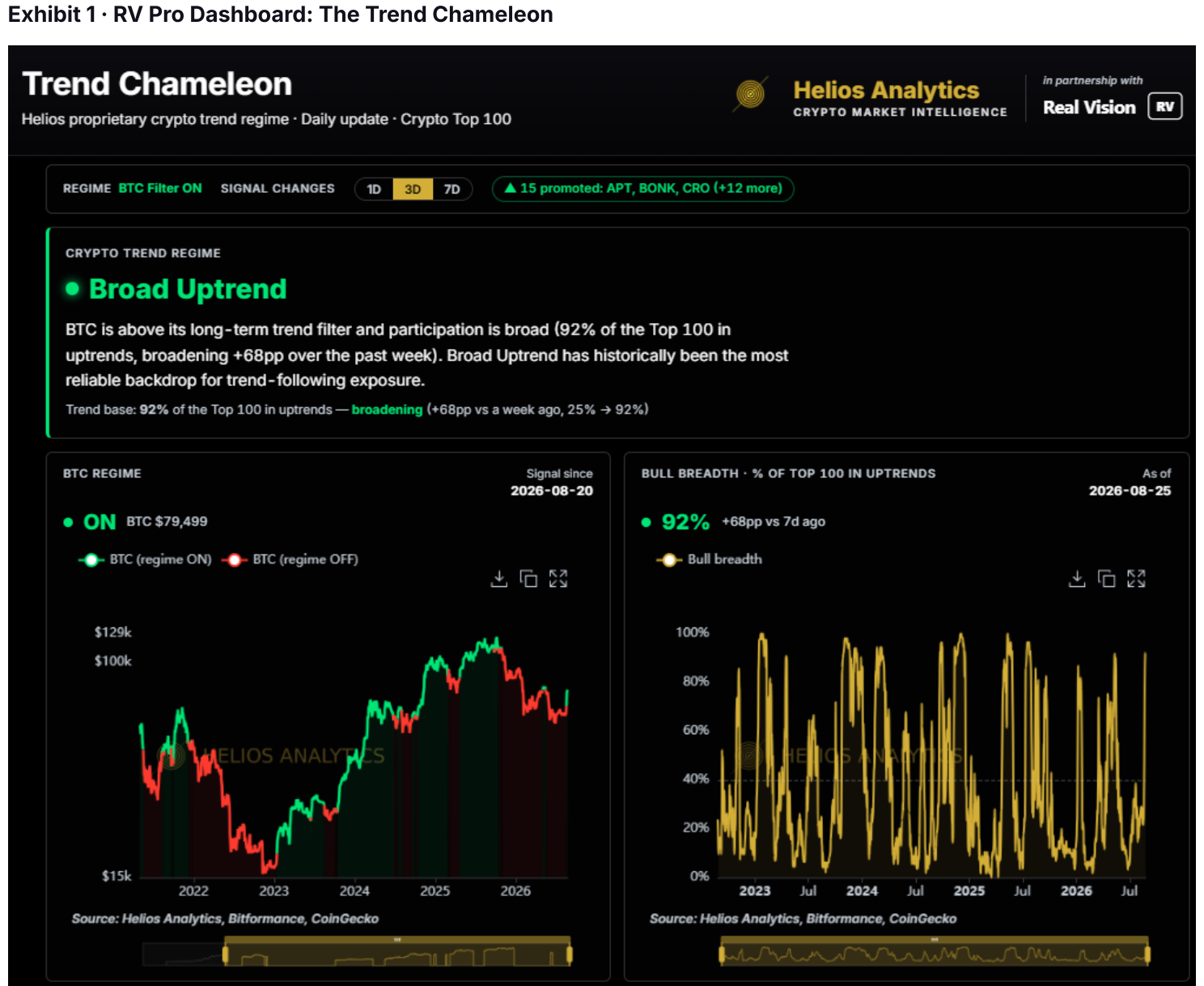
That resolution arrived violently higher. Bitcoin pierced the $69,000 market-regime filter featured on the Trend Chameleon dashboard as the broader crypto market turned with it. The critical 180-day high from the volatility study remains at $82,200, where a cluster of overhead resistance and long-term trend levels coalesces.
Source PDF · page 4Breadth had already begun improving before the breakout, and bullish participation expanded rapidly once Bitcoin moved. The weekly framework still has further confirmation to deliver, but the market is no longer behaving like the same bearish regime that dominated the first half of the year.

The framework was becoming more constructive before last week's move. Through July, relative strength beneath Bitcoin was improving while volatility remained exceptionally compressed. That created an unusual asymmetry: the macro path remained dangerous, but the risk-reward profile within crypto was improving. I began deploying cash before the breakout, particularly outside Bitcoin, because further capitulation was increasingly likely to force a policy response, while an upside resolution would show that the market had absorbed more of the tightening than the macro data implied.
This was deliberately pre-emptive rather than a claim that the macro risks had disappeared. Improving breadth and relative strength gave me enough confidence to move ahead of the slower trend and liquidity confirmations. On 17 July, I put 17% of the portfolio to work from cash while remaining explicit that the signals were still preliminary.
Source PDF · page 5Getting back to the framework, the distinction is now between a regime change and full confirmation. The first has occurred. The second has not. Several of the conditions I laid out in July have nevertheless moved in the right direction: Bitcoin reclaimed the 160-day trend filter, the weekly regime improved, BTC/Nasdaq and BTC/gold moved from bearish to neutral, the dollar failed to extend toward the 105-106 risk zone, and real-rate pressure has stopped accelerating. Global liquidity and the slower relative signals still have more work to do.
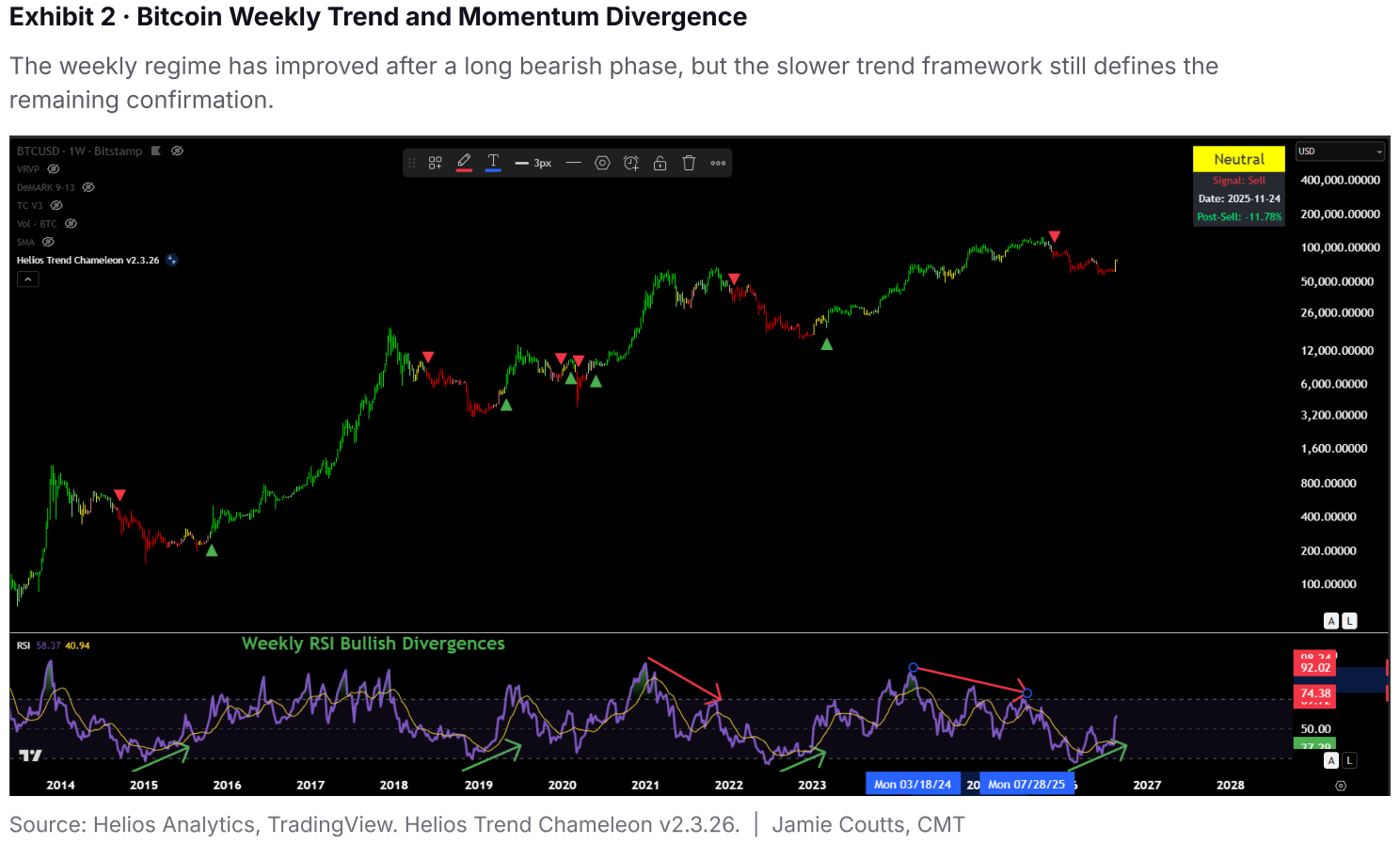
The weekly chart matters most here because that is where the secular trend and major cycle inflections become clearer. The bullish RSI divergence, which has been developing since the February capitulation low, adds weight to the move, particularly given how well the opposite signal worked ahead of last year's top. Just as importantly, the weekly Trend Chameleon has now shifted to neutral. Historically, every move into neutral has marked a meaningful inflection in momentum, while a subsequent flip to bullish has worked in five of the past six cycles, with COVID the lone exception. In all but one of those cases, Bitcoin never returned to retest the level from which it broke out of neutral. Six observations are still a small sample, but the fingerprints of a cycle inflection are increasingly difficult to ignore. The test now is whether that price signal can hold while global liquidity remains constrained, even as the dollar weakens and policy support begins to build.
This Was Not a Normal Bounce
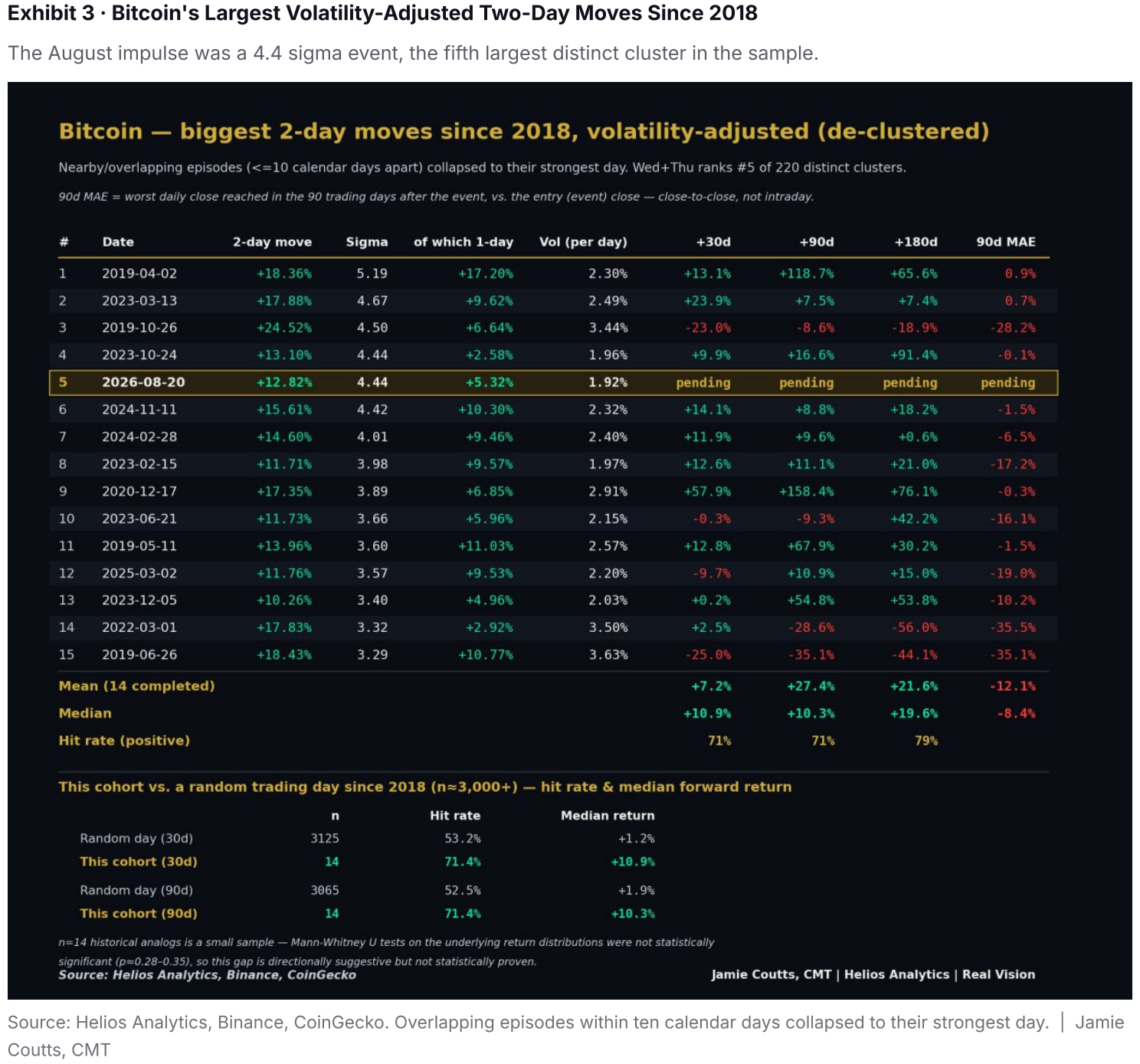
Anyone drawing a trend line could see that Bitcoin had broken its daily downtrend. The magnitude of the move carries additional information. Bitcoin has been in a structural volatility downtrend for years, sO comparing raw percentage moves across cycles flatters the past and understates the present.
Source PDF · page 6Adjusted for the prevailing volatility regime, the two-day advance was a 4.4 sigma event and the fifth largest of 220 distinct clusters since 2018. Across 14 completed analogues, Bitcoin was higher 71% of the time after 30 and 90 days, and 79% after 180 days. Median returns were 10.9%, 10.3%, and 19.6%, respectively. A random trading day since 2018 was positive 53.2% of the time after 30 days, with a median return of 1.2%.
Fourteen observations are not enough to claim statistical significance, but they do suggest a strong probabilistic tilt toward the July low holding. The move was historically unusual and forward outcomes generally leaned positive, although the path was rarely straight: the median drawdown over the following 90 days was 8.4%, with a mean of 12.1%. That still leaves plenty of room for consolidation and another meaningful drawdown within a more constructive medium-term regime.
Breadth Was Changing Before Bitcoin Turned
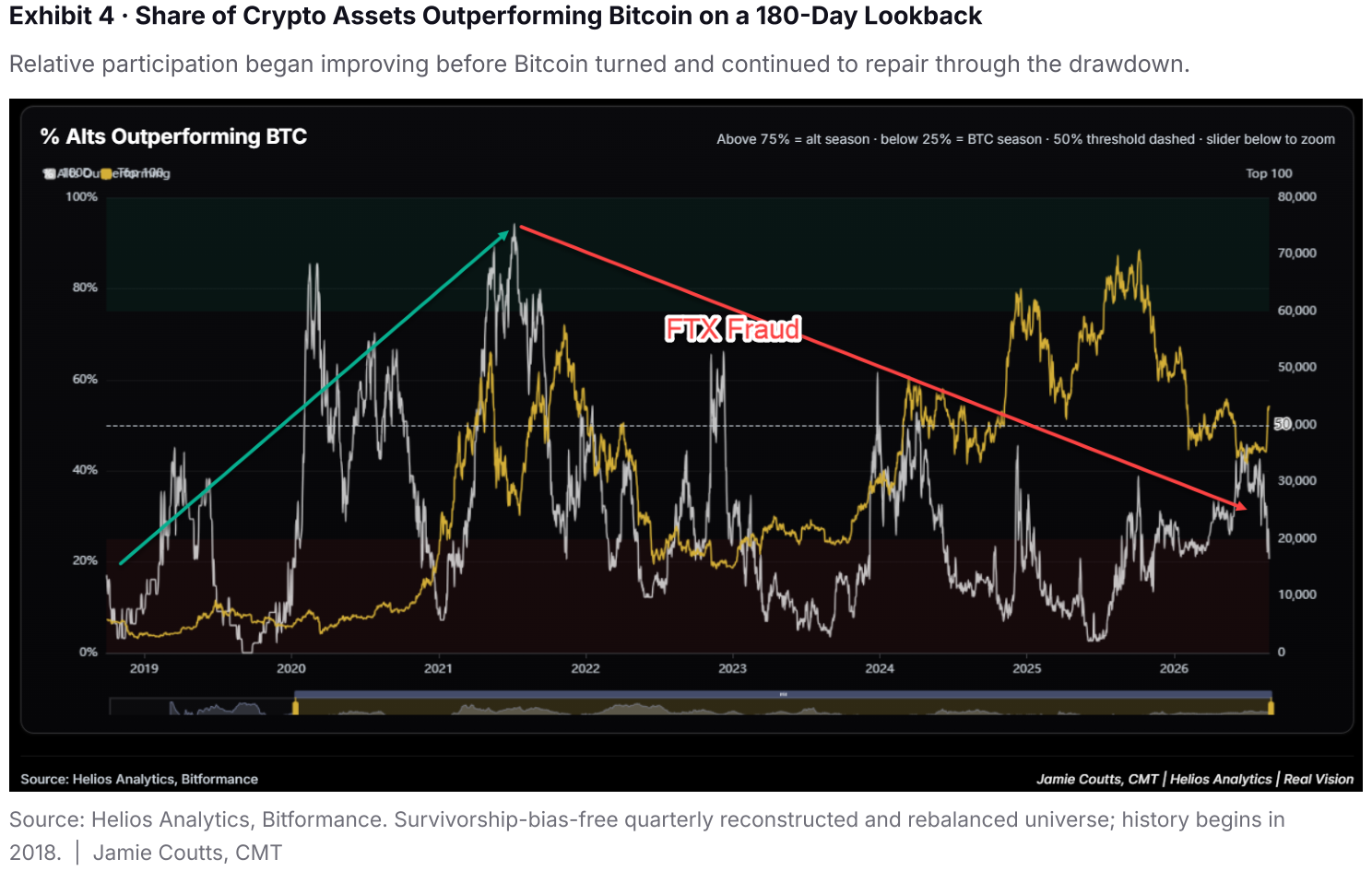
Breadth had already begun to improve before Bitcoin broke out. Participation was extraordinarily narrow throughout the 2023-25 bull market, with Bitcoin and a small group of large assets carrying the market while much of crypto remained in a structural bear market beneath the headline index.
The share of the crypto universe outperforming Bitcoin over 180 days fell to just 4% in July 2025 as Bitcoin approached its peak. That was the opposite of 2017 and 2021, when more than 75% of the Top 100 were outperforming Bitcoin late in the cycle. This time, breadth began repairing during the decline. Even as Bitcoin fell 55% and traded below $60,000 in 2026, the share of assets outperforming it continued to rise. Unlike 2022, when FTX distorted the signal, the improvement was broad enough to suggest a genuine change in participation. The market's internal structure was beginning to turn before Bitcoin itself confirmed the move.
Other measures tell a similar story. The advance-decline line remains structurally bearish, but its momentum has been improving from deeply depressed levels. February produced the second-highest reading on record for the share of assets making 365-day lows, behind only June 2022. Yet Bitcoin's subsequent break lower did not produce a corresponding new extreme in market breadth. At the same time, the share of assets making 180-day highs has begun to rise again. With dispersion returning, relative strength is beginning to carry more information.
Source PDF · page 8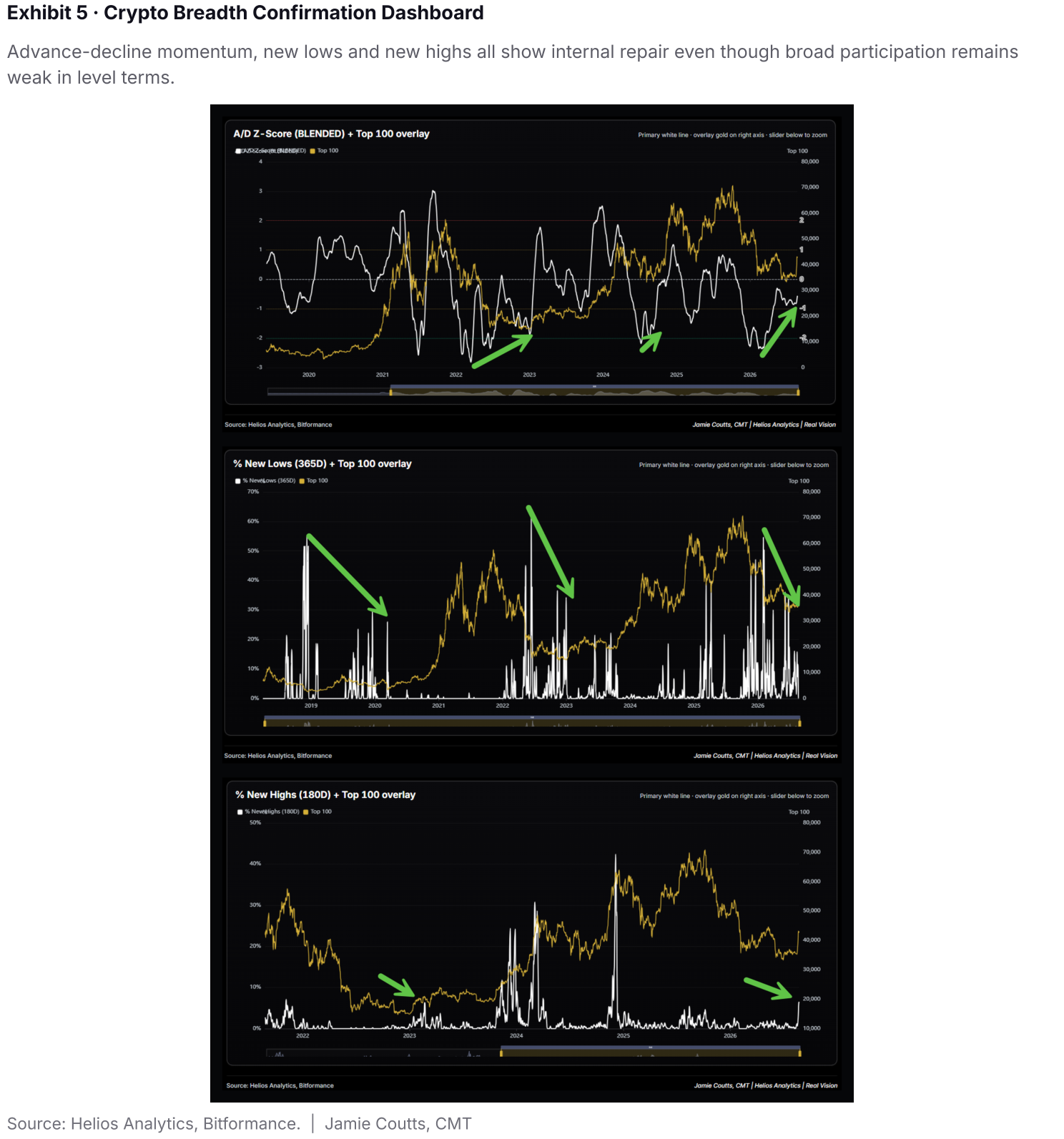
What Has Not Confirmed
The activity data still refuses to give the same answer as price, but for now that's okay. Crypto remains in an activity recession. Stablecoin supply, which had been contracting since May, posted its first weekly rise, increasing about 1%, while daily active addresses have improved by around 5%.
At major crypto inflection points, price has often turned before the broader activity data. That relationship makes intuitive sense. Higher asset values improve collateral, increase risk appetite, and draw capital and users back into the ecosystem. I would still treat it as a historical tendency rather than a rule. Price without improving fundamentals can also produce false starts. The prospective drivers of blockspace demand have never been stronger. Capital moves to where the puck is going.
The longer-term technical picture is similarly incomplete. Bitcoin's weekly framework has improved, but full bullish confirmation has not materialised across all trend measures. Its relative Trend Chameleon regimes against both the Nasdaq and gold have moved to neutral rather than bullish.
That leaves the current setup in an unusual but coherent position. The fast-moving evidence is constructive, while the slower-moving evidence is beginning to follow. Importantly, the macro configuration that drove my July caution has also become less complete: the dollar failed to extend, real yields remain restrictive, but the tightening impulse has not accelerated, and MOVE, credit spreads and funding markets never delivered the systemic-stress confirmation I was watching. The biggest gap remains global liquidity.
Liquidity Has Bounced, Not Broken Out
Global liquidity momentum weakened sharply from its early-2026 peak and reached a local low in June. Since then, it has rebounded. As of 24 August, the 12-month rate of change in the Helios Global Liquidity Index was 6.54%.
The detrended GLI has recovered to +3.08 percentage points. The rebound is visible, but so is the larger structure. Neither measure has escaped the broader decline in momentum from earlier this year.
Source PDF · page 10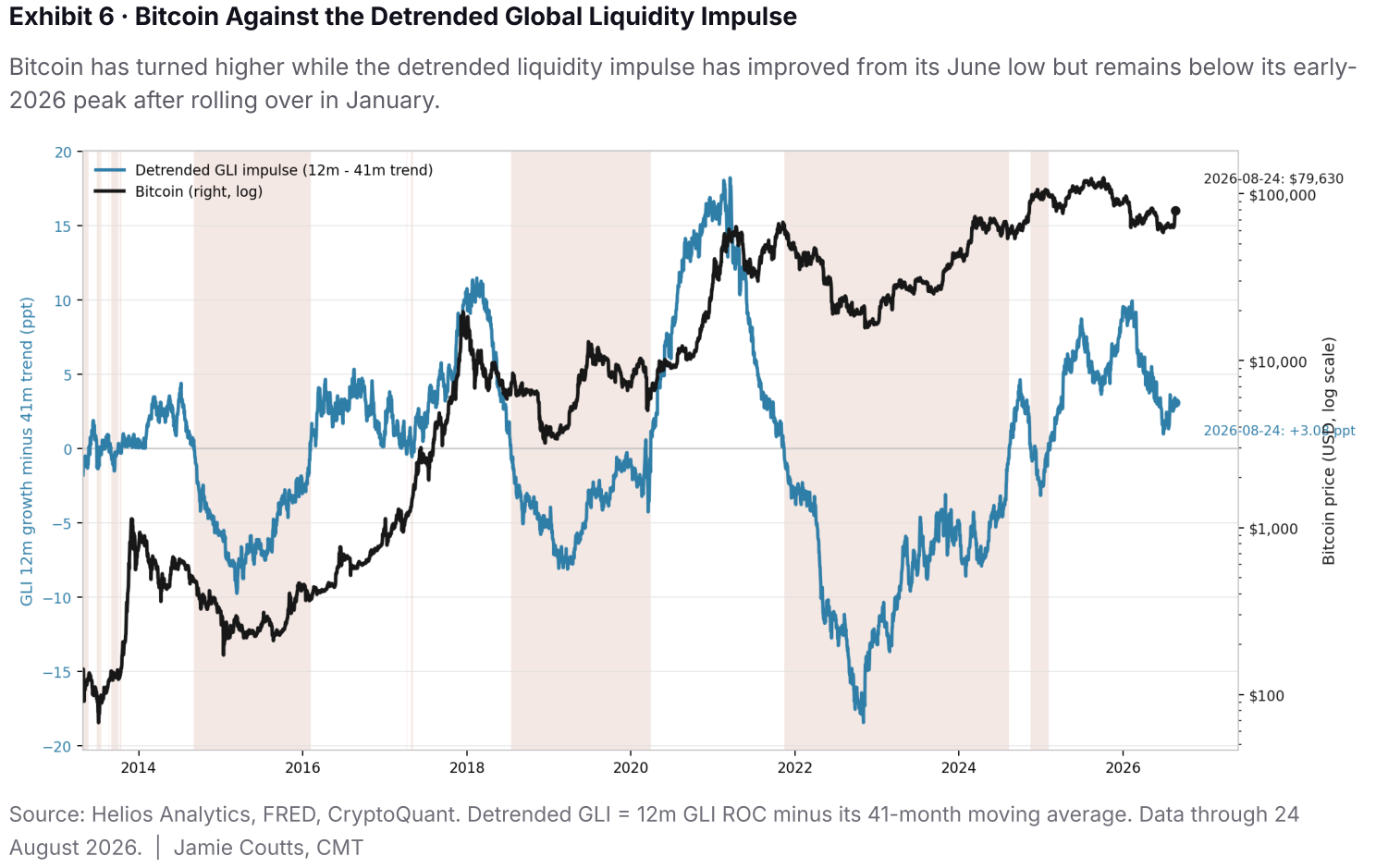
For now, I am treating the liquidity move as a countertrend improvement. A sustained breakout from the declining momentum structure would provide materially stronger macro confirmation for the major-low thesis. Previous tightening cycles also showed that Bitcoin did not wait for the GLI momentum trough. It turned as the deterioration began to ease, shortly before the broader liquidity inflection. That is why the current price signal can be credible before macro confirmation is complete.
There is an important counterpoint. Previous major liquidity troughs have not occurred without the detrended GLI moving below zero. The question is whether the US can tolerate that degree of contraction this time given the accelerating debt burden and growing pressure on balance-sheet capacity. Andreas Steno's latest research adds an important wrinkle. His thesis is that Treasury could fund some buybacks by drawing down the TGA, shifting cash held at the Fed into commercial-bank reserves, and creating a QE-like first-round liquidity effect without an immediate expansion of the Fed's balance sheet. Andreas also identifies the weak link: if Treasury subsequently rebuilds the TGA through issuance, much of that reserve injection is reversed. I therefore view the TGA as a potentially meaningful liquidity bridge, not permanent liquidity.
This is also why I refuse to force the current setup into a rigid four-year Bitcoin cycle, while acknowledging that the refinancing framework I use is not a metronome either. The current liquidity cycle is mature, but that does not require Bitcoin's price to land neatly on an old calendar, whether low or high.
Source PDF · page 11AI makes the timing even less clean. The build-out is changing where capital is being deployed while adding enormous financing requirements to the system. I would treat that as another reason to be cautious about assuming the historical Bitcoin clock must repeat, rather than evidence that AI mechanically creates a longer cycle.
The structural liquidity problem has not disappeared, though. Over the five years to 22 July 2026, US total public debt compounded at 6.84% a year, compared with 2.15% for global liquidity, while the commonly used US net-liquidity proxy contracted at an annual rate of 3.04%.
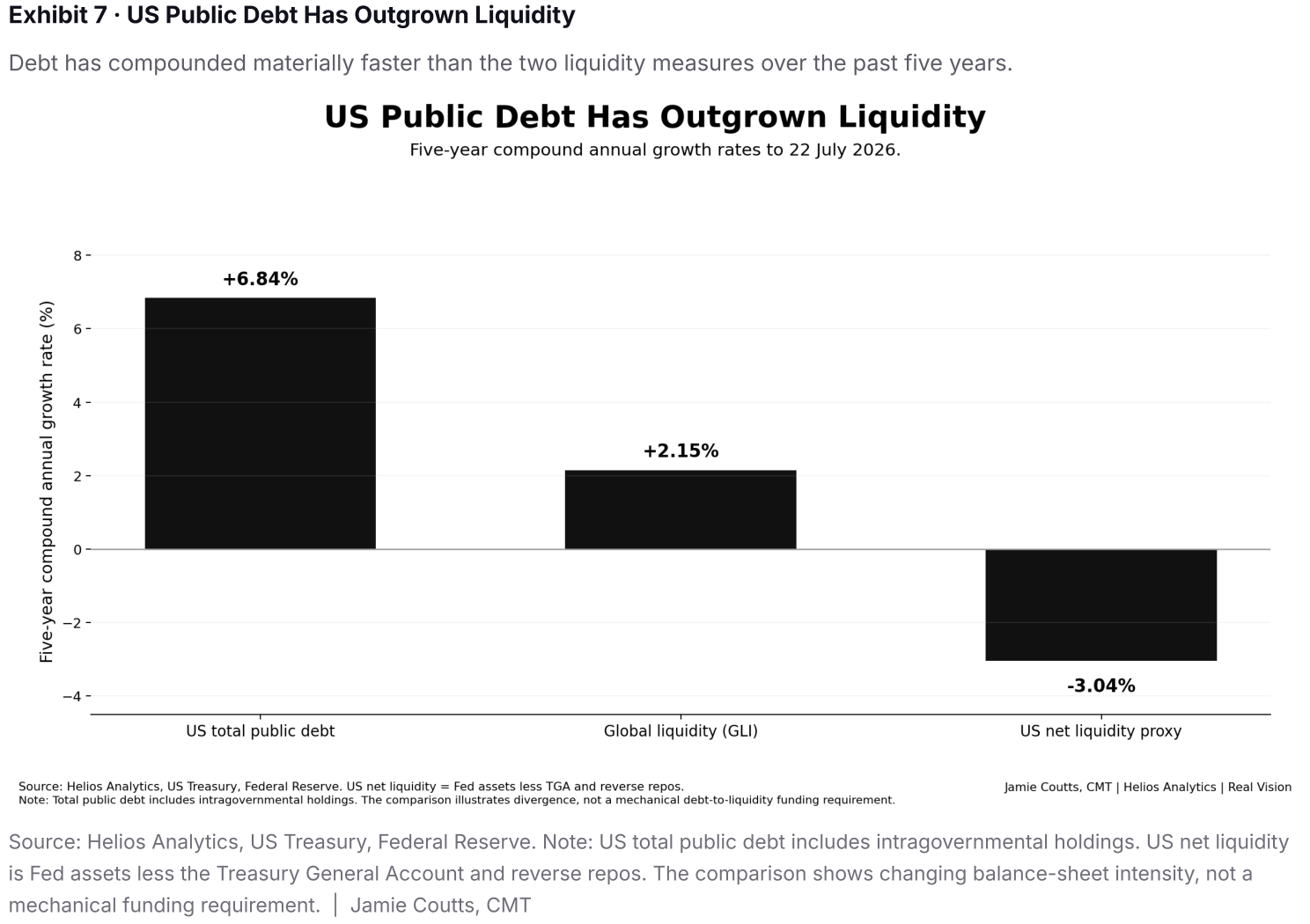
Those comparisons are not mechanical funding requirements. A dollar of debt does not require a matching dollar of central-bank liquidity, and total public debt includes intragovernmental holdings. The direction still matters. The stock of claims has been expanding much faster than these measures of liquidity, while government refinancing, corporate issuance and AI infrastructure compete for balance-sheet capacity.
Source PDF · page 12That is how a probable Bitcoin low and an unfinished liquidity cycle can coexist. Crypto can turn before the macro data, while the refinancing and debt-management pressures capable of producing another major period of stress remain ahead.
Policy Responded Earlier Than Expected
The policy response is one reason I am more willing to entertain that sequence. On 19 August, the US Treasury increased its liquidity-support buybacks in the 10-to-30-year sectors from a maximum of $2 billion to at least $4 billion per operation. Treasury explicitly described the change as providing greater liquidity support to longer-dated nominal securities. Long yields initially fell after the announcement, although the relief did not last.
I read that as evidence of a stronger reaction function around the long end. The scale of the purchases is small relative to the Treasury market and does not solve the debt problem. More importantly, the announcement does not establish that private demand can no longer absorb Treasury issuance, that monetary financing has begun, or that QE is inevitable.
The significance lies in the willingness to respond before market functioning becomes disorderly. In July, my escalation sequence assumed that the dollar and real yields would likely need to be joined by higher MOVE, wider credit spreads, and deteriorating funding conditions before policy became meaningful. That sequence never completed. Treasury acted anyway. The update to my framework is not that the debt-liquidity problem disappeared, but that the policy reaction function has shifted earlier.
Andreas Steno's latest research suggests that reaction function may have more near-term liquidity capacity than the headline buyback envelope implies. His thesis is that TGA-funded buybacks would shift cash from Treasury's account at the Fed into commercial-bank reserves, creating a QE-like first-round liquidity effect without expanding the Fed's assets. That could provide a meaningful bridge and help explain why Bitcoin is turning before the detrended GLI has fully confirmed.
I do not read that as durable reflation. The TGA is operating cash for a government running persistent deficits, not an untapped sovereign wealth fund. If Treasury later rebuilds the account through issuance, much of the reserve injection can be reversed. Andreas explicitly identifies that as the weak link, while his own regime work also shows inflation risk rising, potentially limiting the Fed's willingness to validate Treasury with front-end easing. The broader Real Vision view remains that policy will increasingly need to contain disorderly long-end volatility and improve monetary transmission through the banking system. Earlier intervention can extend the cycle rather than solve the debt problem. I still think a larger Fed role becomes likely if refinancing pressure continues to outrun private balance-sheet capacity, but that remains a macro thesis rather than an accounting identity.
Source PDF · page 13The Secular Story Is Starting to Meet the Cycle
The cyclical turn is happening while two secular themes that developed through the bear market are becoming much more concrete: tokenization and agentic commerce.
Tokenization
The regulatory shift is becoming more important than the legislative timetable. The SEC and other agencies are using their existing authority rather than waiting for Congress to complete market-structure legislation before establishing rules for digital assets and tokenized securities. In August, the SEC proposed a tailored offering regime designed to accommodate crypto-native capital formation while requiring the disclosures investors need to make informed decisions. Earlier guidance also made clear that putting a security on a blockchain does not remove the underlying investor protections attached to it.
That direction has explicit support from the administration. Treasury Secretary Scott Bessent has framed digital assets, stablecoins, tokenization and new payment systems as part of the future of US financial infrastructure, arguing that America should help set the standards rather than allow the technology to develop elsewhere. Importantly, the stated objective is not deregulation at any cost. Bessent has tied innovation to transparency, security, consumer protection and the integrity of the financial system, while Treasury and banking regulators are moving ahead with implementation frameworks for stablecoins and digital-asset activity.
For investors and financial institutions, that changes the calculation. Regulatory uncertainty has been one of the largest barriers to committing capital, building custody and settlement infrastructure, and putting traditional assets onchain. Clearer treatment of ownership rights, disclosure, custody and investor protection does not eliminate risk, but it makes the legal and operational perimeter easier to underwrite. That should increase confidence among institutions that previously had little incentive to move before the rules were clearer.
The blockchain implication follows from adoption rather than regulation itself. If more securities, stablecoins and financial-market activity are issued, transferred and settled onchain, demand for blockspace and settlement infrastructure should rise with it. The investment question remains which networks actually capture that activity and convert it into durable economic value. Not all tokenization will occur on public chains, and greater onchain activity does not automatically translate into token value accrual.
Source PDF · page 14Agentic Commerce
While the impact on blockspace demand is still very small, the foundations for the coming agentic economy are, in some ways, moving even faster. OpenRouter data show that agentic workloads have overtaken human token usage since February and now stand at around 14 times the level recorded at the crossover point six months ago.

OpenRouter separately reports that agentic workloads consume around 15 times more tokens per request than normal human usage. The scale matters because autonomous software requires persistent access to models, data, and services rather than the intermittent usage pattern of a human sitting behind a screen.
The surrounding infrastructure is starting to connect. Stripe announced its acquisition of OpenRouter, linking a major payments platform with one of the main AI model-routing layers. Cloudflare is developing programmable wallets for AI agents alongside stablecoin support and machine-payment protocols including x402 and MPP.
The emerging stack is becoming visible: identity, model access, programmable wallets, machine payments and settlement. Crypto's relevance comes from the last part of that stack. Autonomous agents need ways to hold value and transact programmatically without a human approving every payment. Stablecoins and blockchain settlement are natural candidates for that role.
Rapid agent growth, however, does not mean every blockchain or token captures value. The secular opportunity becomes interesting only where growing economic activity produces durable network usage and value accrual.
Relative Leadership Is Beginning to Turn
The secular story needs evidence that capital is actually beginning to rotate back toward crypto. Bitcoin has spent much of the past year losing relative ground against the assets competing for marginal capital. The Nasdaq captured the secular growth trade through AI, while gold dominated the debasement and fiscal-risk trade. BTC/Nasdaq began to inflect higher in July, but that move coincided with the start of a roughly two-month Nasdaq correction. That is meaningful relative repair, but not yet clean evidence of capital rotation.
Both relative trends are finally becoming less hostile. Bitcoin against the Nasdaq has moved to a neutral weekly Trend Chameleon regime, and Bitcoin against gold has done the same. Stronger confirmation would be Bitcoin continuing to outperform as the Nasdaq itself resumes rising, while also outperforming an already strong gold market. That would show Bitcoin winning growth and debasement capital rather than merely benefiting from weakness in the denominator.
Source PDF · page 16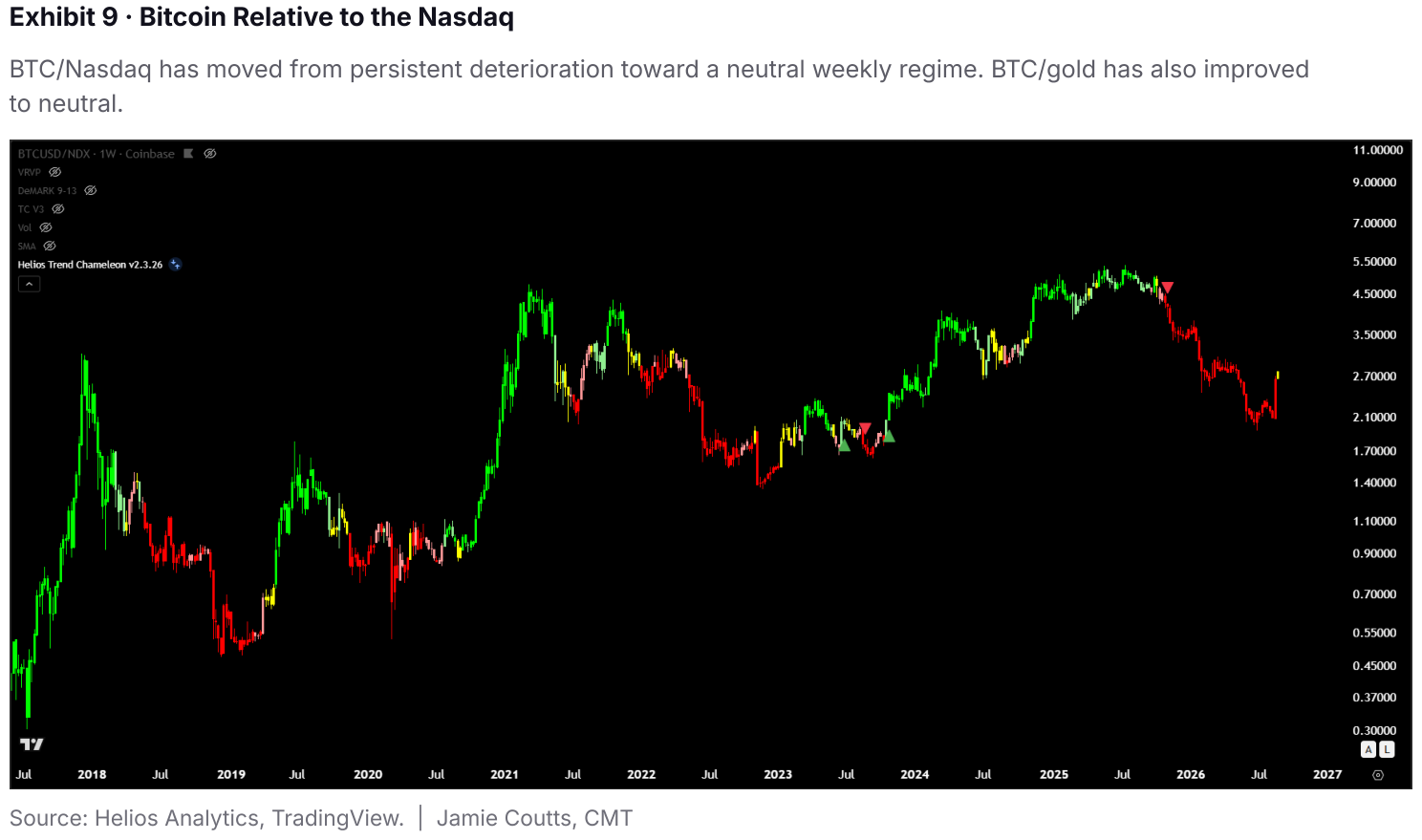
A transition from bearish to neutral on the weekly regime has been sufficient at previous market inflection points to favour Bitcoin from an asset-allocation standpoint.
After the Inflection: Consolidation and Selection
Bitcoin is around $80,000, roughly 30% above the July low, while many crypto assets have rallied significantly, some by 30% to 100%. The market is no longer sitting at the point of maximum opportunity, and Bitcoin now faces meaningful overhead supply in the high-$80,000s. Holder distribution shows a large concentration of invested value in that region, alongside important longer-term technical resistance, including the 180-day high and the weekly Trend Chameleon inflection level. At the other end, the $58,000 to $63,000 area remains the key structural support complex around the recent lows and buyer cost bases.
These are the main zones investors should be watching. After such a violent repricing, I expect Bitcoin to digest the gains for several days or potentially a few weeks before making a cleaner attempt at the high-$80,000s.
Source PDF · page 17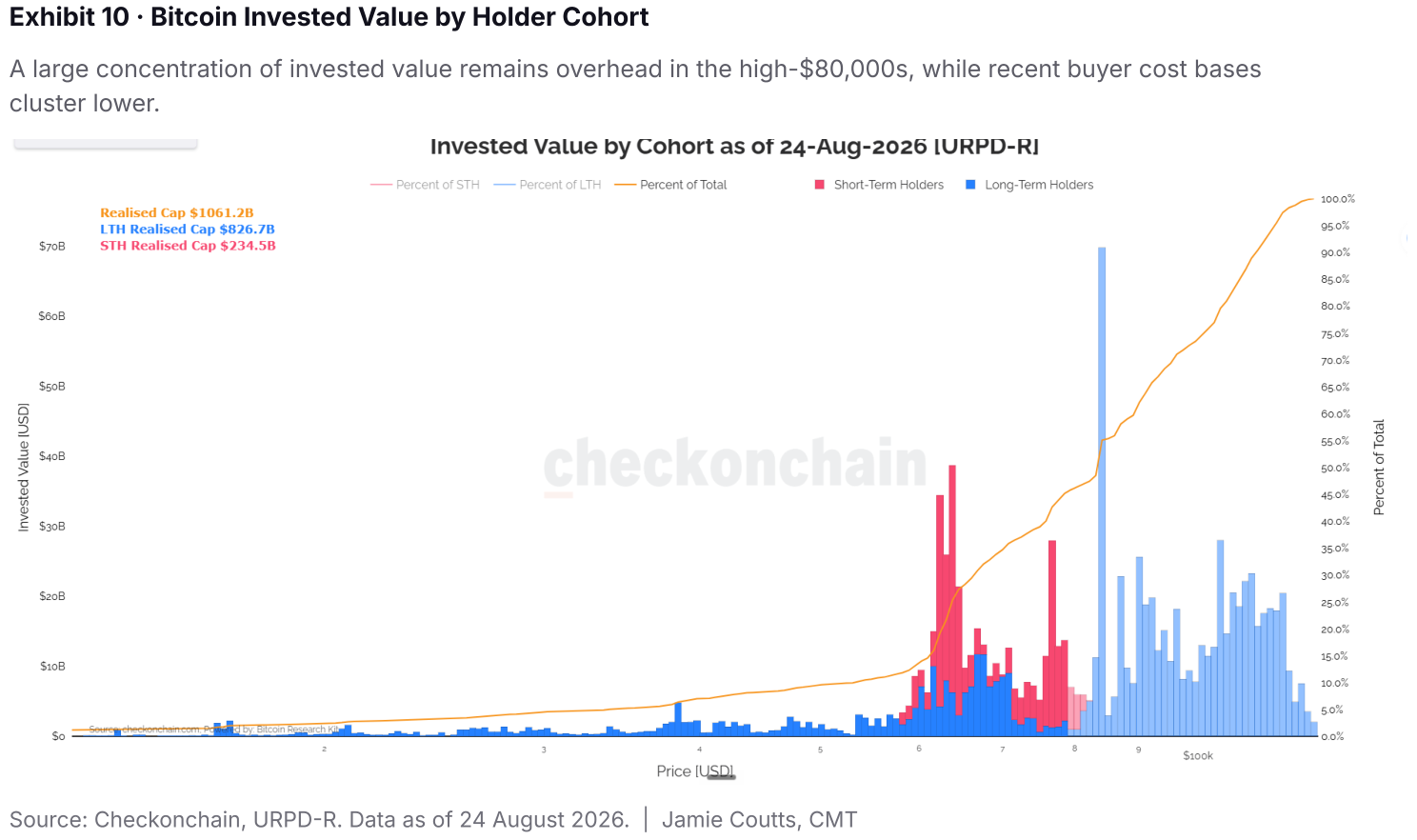
Leverage is another risk to watch. Non-Bitcoin perpetual open interest stands at roughly $36.5 billion against $23.4 billion for Bitcoin, putting 60.9% of total open interest outside BTC. The ratio of 1.56 sits around the 93rd percentile of the past four years, showing how quickly speculative leverage has returned during the rally.
None of this conflicts with the major-low thesis. A market can change regime, rally violently and then spend weeks or months consolidating the initial move. The historical adverse-excursion data suggest that would be entirely normal.
The analytical focus therefore changes after the inflection. Relative strength that survives consolidation matters more, as do fundamentals, secular relevance and the ability of individual networks and assets to capture value from the themes attracting capital. Broad crypto beta was useful around the turn. From here, selection becomes increasingly important.
What Would Force a Reassessment
The major-low thesis does not require global liquidity to turn cleanly higher from here. If GLI momentum rolls over again, I would expect Bitcoin to come under pressure, potentially sharply. But the starting point matters. If Bitcoin first clears the $82,200 volatility breakout and the resistance cluster in the high-$80,000s, a later liquidity-driven correction could be substantial without threatening the July low.
Source PDF · page 18There is another reason I am prepared to lean into the low before macro confirmation is complete. Further liquidity deterioration would intensify the debt-to-liquidity imbalance and move the system closer to the larger policy response I ultimately expect. That does not make tightening bullish for Bitcoin in the short term. It means another difficult leg in liquidity can be consistent with a major low already being in place, particularly if price has established itself materially higher beforehand.
I therefore separate a deterioration in the path from a failure of the thesis. A renewed GLI rollover, stronger dollar, higher real yields or rising bond and funding stress would weaken the near-term outlook, but none would independently tell me that the cycle low had failed. The major-low thesis would come under serious pressure if tightening persisted despite policy action, inflation or term-premium constraints prevented an adequate response, crypto breadth and relative leadership returned to bearish regimes, and Bitcoin then lost the $58,000 to $63,000 structural support complex.
Andreas Steno's TGA work adds another possible stage to that sequence. A TGA-funded reserve injection could soften an initial tightening phase, but some of that liquidity could subsequently be withdrawn as Treasury rebuilds the account. If the Fed remained constrained at the same time, another period of market stress could still be required before a larger response arrived. That would be painful, but it would remain consistent with the July low holding as long as Bitcoin's broader price regime and internal market structure survived.
The constructive case therefore allows for an uneven path: Bitcoin can lead, policy can respond earlier than in previous cycles, liquidity can deteriorate again, and more volatility may ultimately be required to elicit enough support to offset the underlying debt-liquidity constraint. What would change my view is evidence that Bitcoin and the broader crypto market cannot survive that stress without returning to the old bearish regime.
The risk has not disappeared. Debt is still growing faster than liquidity, the refinancing cycle remains mature, and activity has not fully recovered. Those tensions leave plenty of room for substantial volatility even if the major low is already behind the market.
Positioning Into the Inflection
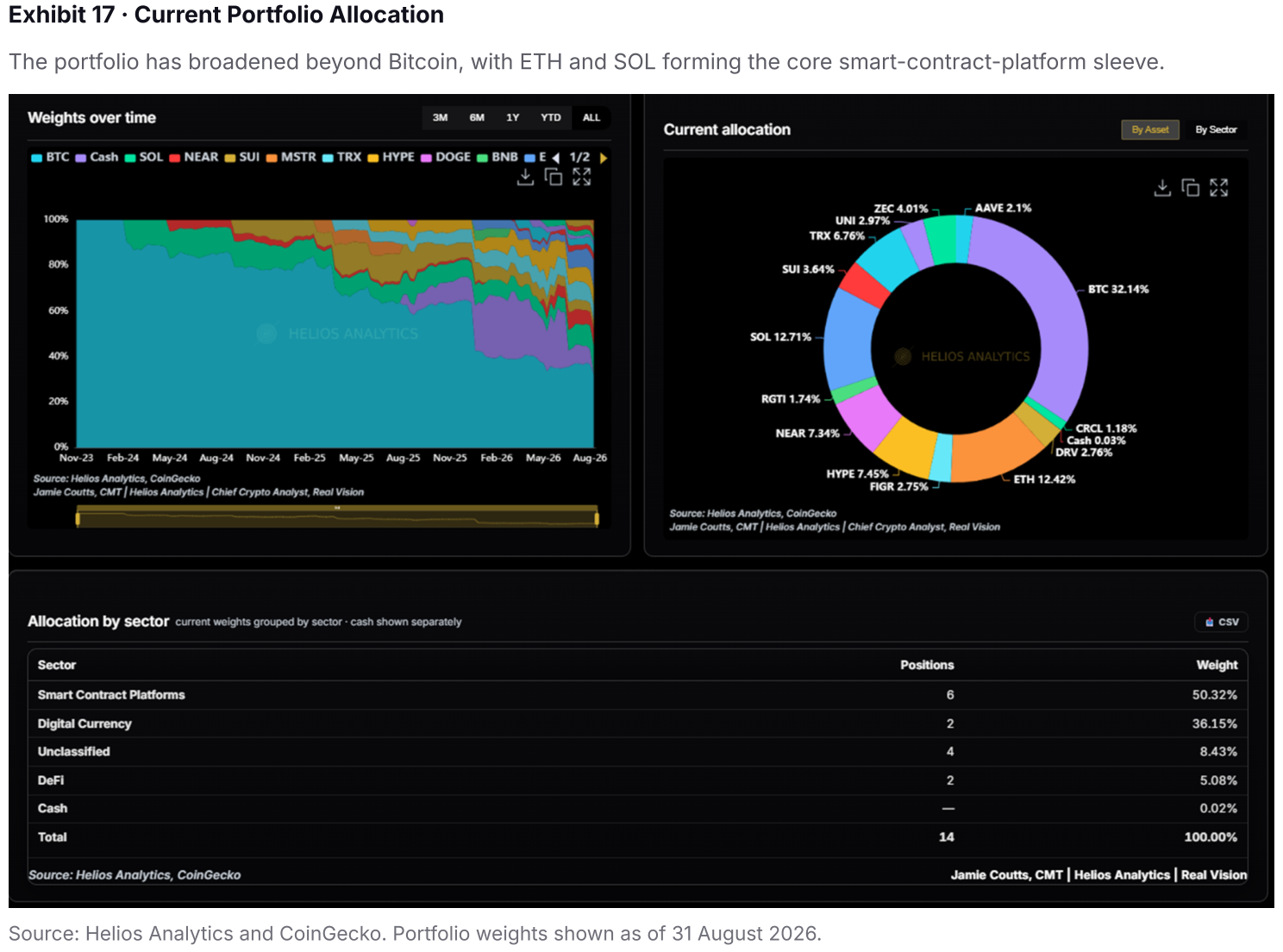
On 17 July, while Bitcoin was still below my major trend filter and the macro backdrop remained difficult, I deployed 17% of the portfolio from cash (leaving 8%) across a group of assets showing improving absolute and Bitcoin-relative trends. The focus was on L1s, but for really the first time in three years I added DeFi protocols.
Source PDF · page 19At the time, I was explicit that the signals were preliminary. The decision was not based on macro confirmation. It reflected a growing asymmetry around the low: breadth and relative strength were improving into significant weakness, while either further capitulation or an upside range resolution was likely to clarify the next regime.
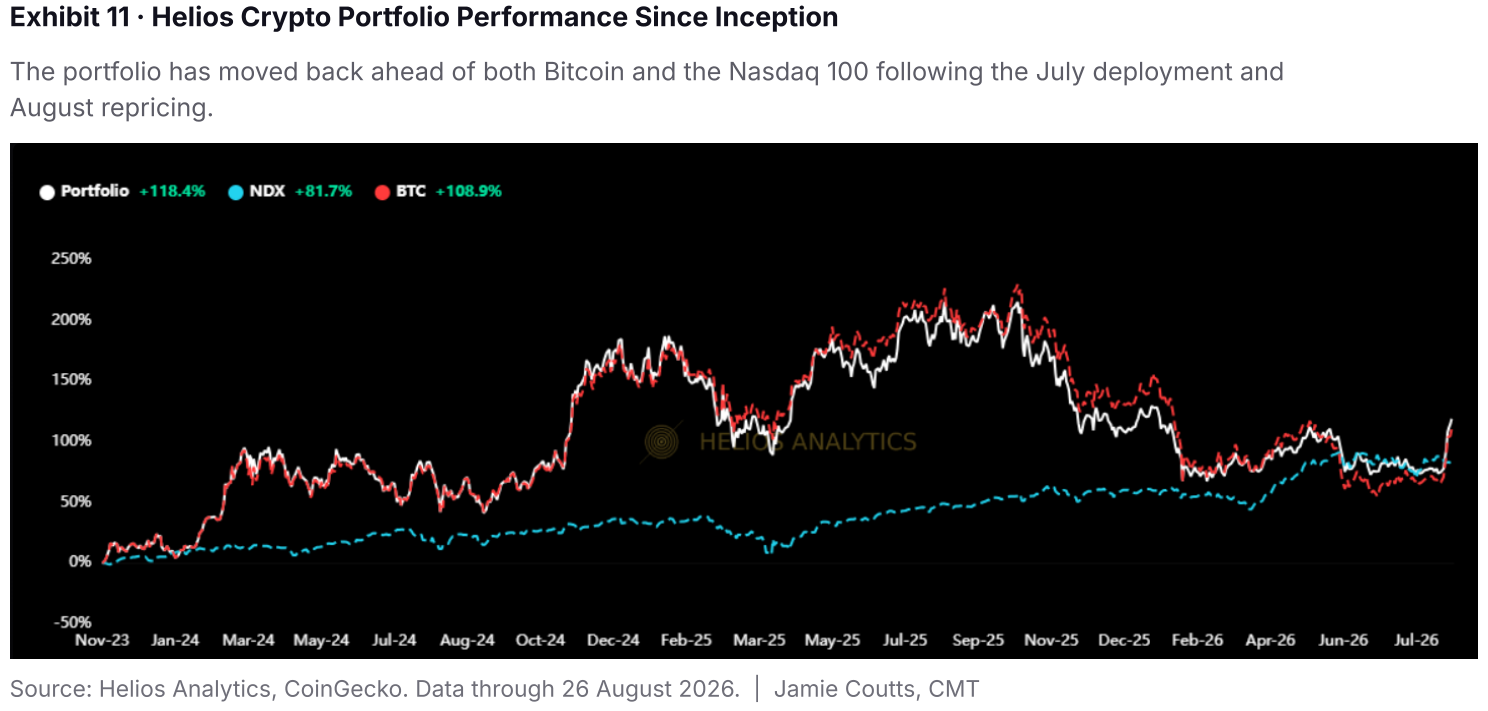
The portfolio's August month-to-date return is 25.5%, taking 2026 performance back to +3.1%. Since inception in late 2023, it is up 118.4%, compared with 108.9% for Bitcoin and 81.7% for the Nasdaq 100. The important point is not the recent performance itself. The deployment occurred before Bitcoin's volatility compression resolved, before the weekly regime moved to neutral, and before the major-low thesis became my base case.
The initial challenge was identifying the inflection and getting capital deployed while the risk-reward remained attractive. The next challenge is portfolio construction in the new regime. Part 2 will focus on the current composition, the changes I am making, and where I see the strongest combination of relative strength, fundamentals, and sustainable value accrual.
Disclaimer: For informational purposes only. Not investment advice. Author may hold positions in assets discussed. Data as of 24 August 2026 unless otherwise stated.
Helios Analytics | Real Vision Pro | v3.7 | August 2026
Source PDF · page 20Jamie Coutts, CMT Chief Crypto Analyst, Real Vision

A pioneer in crypto financial analysis and a sought-after speaker, Jamie has transitioned from traditional markets to digital assets, creating research insights for institutions assessing blockchains and digital assets as part of their strategic investment allocations. Jamie's multi-disciplinary approach blends traditional macro, technical, and quantitative techniques with the emerging field of crypto fundamentals.
Jamie's career started as a stockbroker in Australia before roles as an equity trader at a global macro hedge fund and equity sales in Singapore and London. In 2014, Jamie joined Bloomberg Singapore as the senior Asia Buyside equity specialist, where he later led the regional crypto/digital assets sales and product strategy before launching Bloomberg Intelligence’s crypto asset research product.
Jamie holds a business degree and two technical analysis designations, previously serving on the global board of the Chartered Markets Technician (CMT) Association, where he was also head of APAC Development. Jamie has spoken at conferences across Asia and the U.S. and his research regularly features on crypto podcasts. His content is available via the Bloomberg terminal, as well as Twitter and LinkedIn.
A passionate advocate for personal health, wellness and liberty, Jamie is committed to amplifying solutions that promote greater personal autonomy, economic freedom and decentralization.